iOS & iPadOS App Recommendations
Tablet-platformed courseware. A curated list of iOS / iPadOS apps that complement Sonic’s chapters on acoustics, hearing, modulation, signal processing, and music. Curated rather than exhaustive.
The apps below are grouped by classroom use. Each app’s name links to its canonical Apple App Store listing; where the developer or publisher also maintains a useful home page, that secondary URL is shown after the description. Most of the apps cost a few dollars or less, several are free, and a few (GarageBand, the PhET HTML5 simulations) are produced and maintained by the original platform vendors or research labs.
iPadOS is generally the better platform for these tools — the larger canvas matters for synthesis interfaces, ear-anatomy atlases, and oscilloscope-style visualizations. Most run on iPhone too, but some (DM1 in particular) are designed iPad-first.
Tablet-platformed courseware
 Audiobus 3 — Audio routing between iOS apps; lets a synth feed an effect feed a recorder, all on-device. audiob.us
 DM1 — Fingerlab's drum machine; a touch-first front-end for understanding pattern programming and groove. fingerlab.net
 DR.Lissajous — Interactive Lissajous-figure generator; great for visualizing phase relationships between two sinusoids. drdroth.de
 GarageBand — Apple's free DAW; the obvious first stop for hands-on recording, MIDI, and effects experimentation. apple.com
 iCircuit — Real-time analog + digital circuit simulator; useful alongside any electronics-of-sound discussion. icircuitapp.com
 Incredible Numbers (a.k.a. Numbers!) — Ian Stewart's number-theory playground; useful when introducing ratios, frequencies, and equal temperament. incrediblenumbersapp.com · companion PDF
 Launchpad — Novation's loop-triggering app; lightweight introduction to clip-based arrangement and live remixing. novationmusic.com
 Musica! — Math meets Music — Jürgen Richter-Gebert’s free iPad app: 24 visualizations of the mathematics behind scales, intervals, harmony, and rhythm, each with an interactive experiment and an explanation of the mathematics under it. Several map directly onto pages here — A Sequencer, n over m Rhythms, and Steve Reich’s Clapping Music alongside the Rhythm Playground, and its endlessly-rising-tone activity alongside Shepard Tones. Companion reading: The Mathematics of Music (overview paper) and the IMAGINARY exhibition La La Lab — The Mathematics of Music.
 PhET Simulations — University of Colorado Boulder's HTML5 physics & chemistry sims. Especially relevant: Wave on a String, Wave Interference, Normal Modes, Fourier: Making Waves, and Faraday's Law and Faraday's Electromagnetic Lab. See also the PhET section on the Related Resources page for chapter mappings. phet.colorado.edu
 Ripple Tank — Paul Falstad's classic 2-D wave-equation simulator. Ideal for teaching interference, diffraction, and standing waves. Also available as a browser version at falstad.com/ripple.
 SignalScope X — Faber Acoustical's audio & vibration measurement suite: real-time FFT, octave-band, oscilloscope, level meters, sweep tones. The deepest acoustic-instrumentation app on iOS; ideal for live in-class measurements. faberacoustical.com
 Singing Fingers HD — Finger-paint using the voice; visualizes pitch and timbre as color and trace.
 System Status (free) · System Status Pro: hw monitor (paid) — Techet's device-level instrumentation (CPU, memory, network); handy when diagnosing audio-glitch root causes during a class demo. The Pro version adds deeper sensor read-outs and removes ads. techet.net
 Uzu — Multi-touch interactive light show; an example of generative graphics keyed to gesture.
 WolframAlpha — Symbolic and numerical computation. Handy for plotting waveforms, evaluating Fourier series, or sanity-checking decibel arithmetic. wolframalpha.com
Sound, synthesis & instruments
 Twhirleds — Orientation-aware gestural interface for spatial-audio scenes — in the style of both a padiddle (a spun flat object) and a poi (a whirled tethered weight) — for multimodal mobile-ambient environments. By the second author Michael Cohen. Also on Google Play; mcohen.info.
 WavePad Sound Editor Master's Edition 2020 (Pro) — NCH Software's iPad sound editor: multi-track recording, trim / cut / paste, effects, batch processing. nch.com.au
Musical instruments, performance & production
 Animoog Z — Moog's polyphonic anisotropic-synthesis synth: the “timbre slider” sweeps continuously between wavetables. Successor to the original Animoog (no longer in the store). moogmusic.com
 Audulus 4 — Node-based modular synthesis & signal-processing on a patch-cord canvas. Drag oscillators, filters, envelopes, and math nodes; route audio & control wherever. The clearest hands-on intuition-builder for signal-flow concepts on iPad. audulus.com
 Auxy Studio — Stockholm-based “minimalist DAW”: curated synths, drum machines, and a four-track timeline. Clean visual language; great for teaching arrangement basics without UI overload. auxy.com
 Awesome Xylophone Lite — Tap-to-play virtual xylophone — demonstrates tuned-percussion timbres.
 Beethoven’s 9th Symphony — Score-following / annotated-listening app for the full symphony.
 Chord ai — Nomad AI's neural chord-recognition: point it at any song (file or live) and it transcribes chord changes, beat, and key in real time — a working demo of audio-to-symbolic ML. chordai.net
 Clapping Music — Steve Reich's eponymous piece as a play-along rhythm trainer.
 Congas — Touchscreen conga drums — hand-percussion timbre & technique demos.
 djay — Algoriddim's DJ console (formerly djay 2); useful for beatmatching, EQ, and pitch-shift demonstrations.
 Drop Dots — Tap-and-drop musical-pattern toy — place tones on a field and let physics-driven dots play them.
 Drum Notation by Beat Note — Writes, plays back, and shares drum notation: noteheads on the customary lines and spaces, accents and ghost strokes, swung or straight. A useful companion to the score pane in the Rhythm Playground, which follows the same conventions. beat-note.app
 Figure — Reason Studios' tap-into-a-beat sketchpad: drums, bass, lead, in lockstep tempo and key. Designed for “ten-second song ideas.” Approachable on-ramp to Reason's synth lineage. reasonstudios.com
 flowkey — Piano-learning platform that listens through the device microphone (or pairs over MIDI), follows the score in real time, and waits for the right note before advancing. Strong song catalogue across classical & popular repertoire. flowkey.com
 hearEQ — Ten Kettles' ear-training drill for equalisation: a passage plays with a single mystery band boosted or cut; pick the center frequency & direction. Targeted practice for the audio-engineering ear. tenkettles.com
 Helix Tuner — Blue Mangoo's polyphonic tuner: shows all played notes simultaneously on a spiral pitch-class display, with per-string deviation. Great for visualizing tempered vs. just intonation.
 iKaossilator — Korg's mobile take on the Kaossilator: an XY pad locked to a chosen scale & key, looper underneath. Tap or smear to play; the wrong note isn't reachable. Great for live-improvising in transit. korg.com
 iKoto — Virtual Japanese koto; introduces traditional thirteen-string zither tunings & performance gestures.
 iReal Pro — Technimo's ubiquitous chord-chart play-along app: type or paste any chord progression, choose a style (jazz, Latin, blues, funk…), and a virtual rhythm section plays underneath. The forum-shared chart library covers most of the jazz & popular standards canon. irealpro.com
 Korg Gadget 3 — Korg's mobile DAW: a suite of “gadgets” (each a city-named synth or drum machine) sequenced together on a clip-based timeline. The most fully-featured all-in-one music-production environment on iOS short of Logic Pro. korg.com
 The Liszt Sonata — Score-following / annotated analysis of Liszt's Sonata in B minor.
 Logic Pro for iPad — Apple's flagship DAW, ported to iPadOS with full touch-and-Pencil workflows. Subscription only ($4.99/month or $49/year); the closest desktop-class production environment on tablet hardware. apple.com/logic-pro-for-ipad
 Loopy Pro — A Tasty Pixel's touch-screen looper-DAW-sampler: tap to record, tap to overdub, tap to mute, plus full MIDI-mapped scenes and a clip-launching grid. Successor to Loopy HD. loopypro.com
 Magic Piano — Smule's piano-roll-driven touch piano.
 Mapping Tonal Harmony Pro (MTH Pro) — MDECKS Music's interactive harmony map: chord function, secondary dominants, modal interchange, modulation paths plotted spatially. Companion to Tessitura Pro Scales. mdecks.com
 MIDI SolFa Mode-Go-Round — Joerg Garbers' modal-pitch playground: rotate through diatonic modes (Ionian, Dorian, Phrygian…) and hear how the same intervallic skeleton recolors under different tonal centers.
 MobMuPlat — Daniel Iglesia's “Mobile Music Platform”: an iOS host for Pure Data (Pd) patches, with a companion desktop editor for laying out custom touch interfaces (sliders, XY pads, buttons, MIDI / OSC bridges) over the Pd audio engine. Great for porting Pd synthesis & spatial-audio sketches to a handheld instrument. danieliglesia.com/mobmuplat
 Moises — ML-based source separation: upload any mix, get isolated vocals, drums, bass, and instrumental stems. Also detects key & tempo, slows down without pitch-shift, and offers per-stem pitch shift & mute. The most accessible front-end for the spectral-masking / deep-learning stem-separation literature. moises.ai
 Model 15 — Moog Music's faithful iPad recreation of the classic Model 15 modular synthesizer (1973). Patchable analog modules — oscillators, filters, envelope generators, mixers — with audio-quality emulation. A real lesson in subtractive synthesis. moogmusic.com
 Musyc — Fingerlab's physics-music toy: drop shapes onto a 2-D surface and listen as they bounce, collide, and trigger sequenced notes. Striking demonstration of “code-as-music” without any code. fingerlab.net
 NaadSadhana — Indian classical music practice tool: drone, tabla accompaniment, raga reference. naadsadhana.com
 Navichord — Denis Kutuzov's tap-a-chord sequencer: pick a key & mode, then trigger diatonic chords with one finger — a hands-on way to internalise harmonic function before fingering full voicings.
 The Orchestra — Score-and-instrument explorer hosted by Esa-Pekka Salonen; excellent for orchestral-timbre comparison.
 PdParty — Daniel Wilcox's open-source iOS runner for vanilla Pure Data patches (and RjDj-style scenes): drop a `.pd` file in, get accelerometer, location, MIDI, and OSC bound to its inlets — minimal UI shell, patch is the program. Complement to MobMuPlat when the patch itself (not a custom UI) is to be the instrument. danomatika.com/code/pdparty
 PolyNome Pro: Drum Sequencer — Joe Crabtree’s programmable metronome and practice sequencer (PolyNome Ltd; iPhone, iPad, Mac, and Vision Pro). Sample-accurate in any time signature, including irrational meters such as 4/5, with accents, flams, drags, rolls, and ties; two- and three-way polyrhythms with animated visualizations; and two independent sequencers that can run overlapping rhythms or different time signatures at once. Practice playlists with automated tempo changes and voice cues, goals, a log of every exercise with PDF/CSV export, and printable setlists for live work. The base app is the cheaper entry point, and “Pro” is available both as this separate app and as an unlock inside it. The drill it is built for — internalising one rhythm against another — is what Sonic’s Rhythm Playground puts on a circle to be looked at. polynome.net
 RapMushi — Beat-and-rhyme construction toy.
 Reactable Mobile — The mobile port of Sergi Jordà's tangible Reactable: a tabletop modular synth where on-screen pucks (oscillators, filters, sequencers, controllers) connect through proximity, with the connection graph drawn live between them. A canonical HCI-meets-music interface for teaching signal flow. reactable.com
 SampleTank — IK Multimedia's sample-playback workstation for iOS: thousands of multisampled instruments (pianos, brass, strings, drums) with MIDI sequencing. Also a free SampleTank CS intro edition. ikmultimedia.com
 Singing Fingers — Sing-and-paint, original (non-HD) edition.
 Singscope — Springwell Music's vocal-pitch visualizer: real-time fundamental tracking on a scrolling staff; useful for ear-training and intonation feedback.
 SoundHound — Music recognition via audio fingerprinting; quick example of constellation-matching.
 SWAM Violin — Audio Modeling's physically-modeled solo violin (now v3); expressive continuous-control bow + vibrato make it a vivid example of model-based synthesis vs. sample playback. audiomodeling.com
 Synth One — AudioKit's free, open-source professional analog synthesiser: full subtractive engine with two oscillators, FM, sub-osc, ring mod, filter envelope, LFOs, arpeggiator, delay, and reverb. Built on the AudioKit framework so it doubles as the canonical example app of that ecosystem. audiokitpro.com
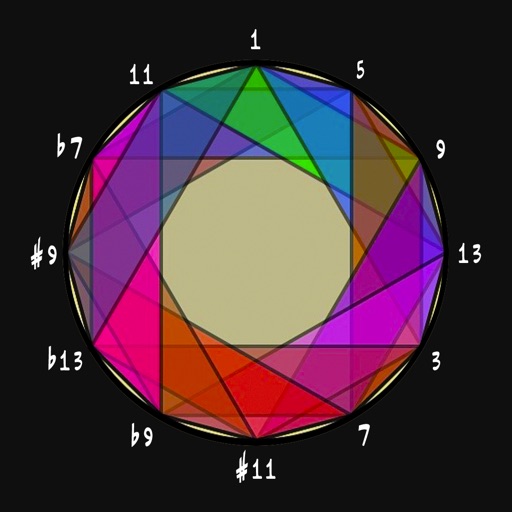 Tessitura Pro Scales — MDECKS Music's scale & mode encyclopedia: all 2048 possible scales in the 12-tone system rendered on piano, pitch map, MIDI grid, and Circle of Fifths, with practice workouts that cycle through all 12 keys for transpositional fluency. mdecks.com
 Theremin Synth — Record & Loop — Luke Phillips' touchscreen theremin with multi-touch effects, multi-waveform selection, and a built-in looper: tap to record a phrase and hear it back — an honest demonstration of how hard consistent pitch is to hold on a continuous gestural instrument.
 Virtual ANS 3 — Alexander Zolotov's emulation of the 1937 Soviet ANS photo-electric synthesiser. Paint sound directly on a piano-roll spectrogram — horizontal axis is time, vertical is pitch, intensity is amplitude — and additive-resynthesis plays it back. The most direct way to teach the time-frequency picture as a literal canvas. warmplace.ru
 Virtuoso Piano — Classic on-screen piano; full 88-key range for harmonic experiments.
 Vocal Image — AI-driven voice coaching: real-time biofeedback on pitch, pace, resonance, and prosody, with exercises for projection, articulation, and accent. Useful adjunct to the singing- and speech-related chapters. vocalimage.app
 Who Sampled — Catalogue of musical samples, covers, and remixes — great for popular-music chain-of-influence discussions.
 Yousician — Multi-instrument learning platform (guitar, piano, bass, ukulele, voice): listens through the device microphone, follows tempo, scores accuracy, and gates progression on hitting the right notes. The most polished gamified-practice front-end on iOS. yousician.com
Anatomical & physiological apps related to hearing
General anatomy
 Visible Body: Human Anatomy Atlas 2026 (ヒューマン アナトミー アトラス) — The standard 3-D anatomy atlas; ear and brain modules are particularly useful for audiology students. visiblebody.com
Anatomy Sciences series
A coherent catalog of audiology-oriented teaching atlases from the same developer — ear anatomy, ear pathology, and speech-articulation formant geometry.
Ear ID family
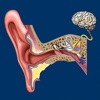 Hearing: Ear ID — Structures of the ear, drillable.
 Hearing: Inner Ear ID — Cochlea, semicircular canals, organ of Corti.
 Hearing: Middle Ear ID — Ossicles, tympanum, eustachian tube.
Ear Disorders family
 Ear Disorders: Inner Ear — Sensorineural-pathology atlas (presbycusis, Menière's, noise-induced hearing loss).
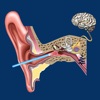 Ear Disorders: Outer & Middle Ear — Conductive-pathology atlas (otitis, otosclerosis, tympanic perforation).
Vowels family
 Vowels Central Diphthong — Central vowels and diphthong transitions in formant space.
 Vowels Front and Back — Formant geometry of the cardinal vowels along the front/back axis.